When it comes to supporting culture and the creative fields, funding is one of the hottest topics around. The City of Brno supports artists, creative professionals and cultural organisations it doesn’t directly run – chiefly through its grant system. So why go down this particular route? And how does the whole system actually work? Let’s peek behind the curtain of culture and creativity funding in Brno.
Why grants?
Cities grant funding to organisations they don’t set up, based – among other things – on Act No. 250/2000 Coll. on budgetary rules for territorial budgets. Grants offer a clear and transparent way to channel public funds into projects that serve the public interest. They give the city a clear framework to set out support conditions, assess applications fairly, and check that funds have actually been used for their intended purpose. That is exactly why grant systems are the go-to tool for supporting culture and other areas of public life.
One system, many forms
Not all grants are equal. They vary in their purpose, how they’re delivered, and how long the support lasts.
Funding can flow through grant programmes with set conditions and a clear thematic focus, or through individual grants supporting specific projects that fall outside standard funding schemes.
Depending on the nature of expenditure, we draw a distinction between non-investment grants – which support the actual organisation of cultural activities – and investment grants, aimed, for example, at acquiring technical equipment or creating assets that meet the accounting definition of an investment.
Multi-year grants are another key instrument, giving organisations the freedom to plan their activities more effectively and deliver long-term projects. Alongside these, traditional one-year grants are also provided.
Yet they all have one thing in common – championing projects that deliver real cultural value to the public and truly serve the public interest.
How has Brno’s grant system evolved – and where is it headed next?
Brno has a long history of supporting culture through grants. The most significant transformation of the system took place after 2014. Sector-specific grant programmes were launched, independent experts were brought in to assess applications, and multi-year support was added to the mix.
The conditions of grant programmes and the way applications are assessed keep evolving, making the system clearer, more user-friendly and more effective than ever. The grant system isn’t set in stone – it’s a dynamic tool that adapts to the ever-changing needs of the cultural sector and the real-world experiences of applicants.
We regularly talk through its format not just with specialist evaluators of grant applications, but directly with support applicants too. Every two years, we run an evaluation of the grant system – usually through an online survey of applicants. When needed, we top up feedback with one-to-one consultations. We take every suggestion seriously and put them to work in developing the system further. Relevant feedback is then fed directly into updates to the terms and set-up of future grant calls. You can find the latest grant system evaluation results right here: https://dotace.brno.cz/oblastkultury/informace (available only in czech). The latest survey wrapped up in 2025 – but engagement from cultural stakeholders was remarkably low (just 3 responses), making the results too limited to take further. The next survey is on track for 2027.
On top of continuously fine-tuning our grant programmes using feedback from applicants and expert evaluators, we are gearing up to take further steps to streamline and enhance the whole process. The Brno City Municipality has long been working towards a brand-new, unified electronic grant portal for submitting applications – one that promises applicants a much clearer and more user-friendly experience. We’re expecting it to launch sometime next year.
As well as its regular programmes, the city regularly puts out special grant calls to address emerging needs. Past highlights have included programmes to cushion the blow of the Covid-19 pandemic, support projects tied to the RE:PUBLIKA festival or the 130th anniversary of architect Bohuslav Fuchs’s birth, plus an investment programme geared towards buying technical equipment and musical instruments.
Since 2021, the creative industries have had their very own dedicated grant programme: For Creative Brno.
Culture and creativity – similar goal, different angle
Both grant systems support the cultural and creative fields, but their focus is quite different.
Culture grant programmes – run by the Cultural Services Unit of the Culture Department of the Brno City Municipality – support a wide range of creative fields, including music, theatre, dance, folklore, literature, fine art and photography, cultural and educational activities, music clubs, and audiovisual production (excluding film production).
The For Creative Brno programme – managed by the Strategic Development and Cooperation Department – is all about architecture, design, gaming, advertising, and crafts. Support is geared more towards driving business growth, innovation and new products – and this is reflected in the programme conditions.
The number of applications submitted differs depending on the area of support. In the area of culture, we often record over 300 applications annually, while support for the creative fields typically attracts dozens of applications in individual calls (up to 30 applications per call). The level of funding distributed mirrors this picture.
In 2026, the City of Brno channelled over CZK 38 million into culture through grant programmes. Once individual grants are factored in, total cultural support reached an impressive CZK 90,070,000. The For Creative Brno grant programme is designed to support projects in the creative sector – with CZK 1.5 million available in 2026.
Film production got a boost from the South Moravian Film Fund, jointly set up by the Statutory City of Brno and the South Moravian Region Authority. That said, the fund’s activities were brought to a halt in 2025 following the Czech Ministry of Finance’s opinion of 28 May 2025 on whether territorial self-governing units may legally establish foundations and endowment funds. From 2026 onwards, support for film production is channelled through the South Moravian Region Authority’s grant programme, boosted by a city donation of CZK 8 million.
Where can you find the information you need?
If you are interested in the conditions of grant programmes, call deadlines or how to submit applications, the primary source of information is the portal dotace.brno.cz. Here you’ll find a full overview of all the City of Brno’s grant programmes, plus the latest information for applicants.
Grant applications across the cultural and creative fields are all handled electronically through dedicated specialist systems.
If you’re into data and deeper analysis, you can also tap into the open datasets provided by the City of Brno. These let users follow how funding for the independent cultural scene and creative fields has evolved over time, and dig into detailed information on how grant funding is distributed.
→ Funding for Brno’s independent cultural scene
→ Funding for creatives (available only in czech)
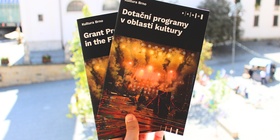
On top of the grant calls, the Culture Department also brings a range of handy support tools to help applicants find their way around the system. Every year, it puts out an electronic and printed brochure, Grant Programmes in the Field of Culture, creates a handy video guide, How to Submit a Grant Application, and runs free training sessions on submitting and settling grants – all as part of the Culture Brno workshop series.
The training is conducted in Czech. However, the information brochure is also available in English. Teaming up with Brno Expat Centre, the Culture Department also puts on a workshop for English-speaking participants once every two years.
When can you apply for a grant?
Deadlines differ across the various grant programmes and calls.
When it comes to culture, applications for sectoral grant programmes are typically submitted from mid-August through to the end of September. And this year is no exception – you can submit your applications from 15 August 2026.
For special grant programmes, deadlines can vary quite a bit.
In the area of creative fields, calls are typically announced twice a year. The 9th call is now open – submit your application between 27 July and 27 September 2026.
Alongside grant programmes, you can also apply for individual grants at any time throughout the year. These are aimed at projects of exceptional, city-wide significance that don’t fit into any of the existing grant programmes.
On top of grant programmes, applicants can apply every year for the Mayor of Brno’s patronage – available as either financial or non-financial support. As part of the patronage, the financial contribution is typically up to CZK 50,000 – though in exceptional cases, an even higher amount can be awarded. Of course, any contribution depends on the availability of funds set aside for this purpose. The funds allocated to support events taking place in 2026 have already been used up.
That said, there are plenty more support options out there. Other grant programmes are also put out by other departments of the Brno City Municipality – for instance, the Education and Youth Department supports projects focused on working with children and young people, the Social Welfare Department champions the integration of national minorities, and the Monument Care Department offers investment grants for restoring cultural monuments. You can find an overview of all the city’s grant opportunities on the portal dotace.brno.cz.
For the long-term stability of organisations, it is important not to rely on a single source of funding. Beyond the City of Brno’s support, there’s a whole world of funding out there – from South Moravian Region and ministerial grant programmes to a broad array of endowment funds and other grant funding opportunities. That’s why, as part of the Culture Brno workshops, we also run educational events focused on non-grant fundraising and diversifying funding sources. The next workshop will take place on 24 September 2026. Save the date in your diary now – registration opens at the end of August.

.png/94bf3343-44c1-100b-c3ba-ce732a0aebdd&w=280&h=140&op=thumbnail)